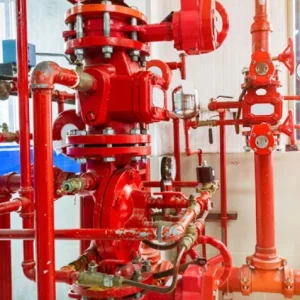




Description
The Bladder Tank is a crucial component in Foam-Water Extinguishing Systems, designed to supply the extinguishing agent to the firefighting network. Utilizing the hydraulic pressure from water flow, this system operates without the need for external driving forces, making it highly efficient. This self-sufficiency is one of its greatest advantages, ensuring reliable performance in fire fighting scenarios.
Details and features
Foam Bladder Tank
The Foam Bladder Tank consists of two storage compartments, one placed inside the other. The inner compartment, made of flexible thermoplastic, stores foam, while the outer compartment, constructed from carbon steel, holds water. The tank’s capacity ranges from 500 to 15,000 liters and it can proportion foam at concentrations of 3% or 6%, in both vertical and horizontal orientations. The pressurized components of this system are manufactured in accordance with ASME Section VIII standards.
Foam proportioner bladder tank
This equipment is a key component in a foam fire fighting system. The foam concentrate is stored in the rubber bladder within the tank and is accurately injected into the water at a precise percentage before being delivered to the extinguishers.
Engineering point of view
Foam bladder tanks and proportion controllers are used to mix foam concentrate and water at precise percentages for firefighting applications. The bladder tank ensures a constant foam-to-water ratio, even if the flow rate or pressure changes during the process. This adaptability allows bladder tanks to function effectively in various firefighting strategies, including manual systems and automatic sprinklers, which operate under different flow rates and pressures.
The foam bladder tank is a carbon steel pressurized tank containing an elastomer bladder that separates the foam concentrate from the water. The bladder tank allows the high pressure of water to be transferred to the foam concentrate without mixing them. A proportioning system, utilizing a venturi, creates a pressure drop in the water stream. As the pressure of the foam concentrate exceeds that of the water, the foam flows into the water and mixes with it. The foam-to-water ratio is dependent on the speed of the water flow.