


Description
A fire hydrant is a crucial device used to extinguish fires and has a variety of applications. These valves are one of the different types of valves typically connected directly to the municipal water supply. Most fire hydrants are used in commercial, educational, and public environments, where they prevent the spread of fire by distributing water.
Fire hydrants come in various types, each offering unique features and applications. Understanding the different types of fire hydrants can help you choose the right product for your needs. Additionally, it is essential to have comprehensive information about the features of each type of fire hydrant before making a purchase.
Details and Features
Fire fighting valves are essential devices used to extinguish fires and have a variety of applications. These valves are typically connected directly to the municipal water supply and are commonly used in commercial, educational, and public environments to prevent the spread of fire by distributing water.
There are various types of fire fighting valves, each offering unique features and applications. Familiarity with these types can help you choose the right product for your needs. It is crucial to have comprehensive information about the features of each valve before making a purchase.
A fire valve is a device used to shut off, regulate the flow rate, or divert the flow of a fluid (such as gases or liquids) by closing, opening, partially opening, or diverting a pathway (such as a channel or pipe). Valves come in many different types based on their mechanism, type, application, and size, and play a vital role in various fields, including firefighting.
Different types of fire fighting valves
1- Fire Hydrants
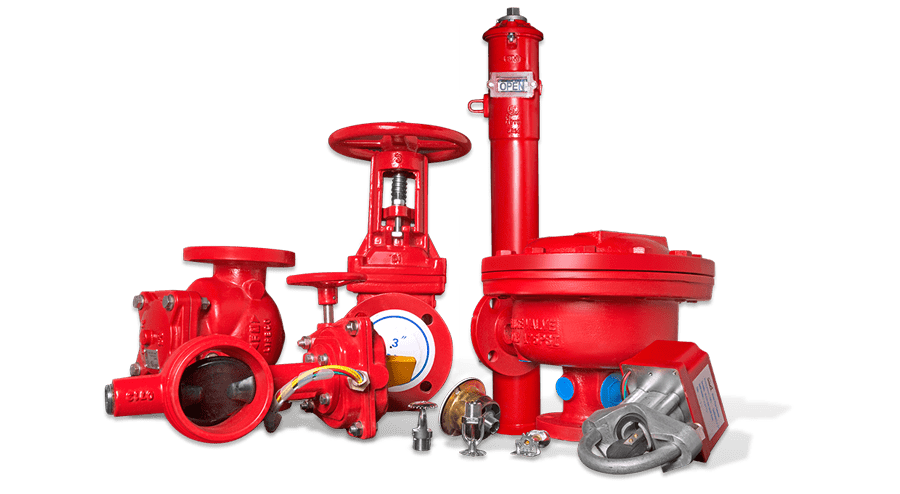
Fire hydrants are used to extinguish fires in various locations, including organizations, commercial establishments, educational institutions, and more. These fire hydrants are directly connected to the area’s water supply, ensuring that firefighters have easy access to sufficient water during a fire emergency. Standing fire hydrants are classified into two categories: above-ground and underground.
2- Test and Drainage valves
In a fire extinguishing system (sprinkler network), these valves are used to test the system’s performance and drain excess flow. Drain valves are typically made of stainless steel or brass. When selecting test and drain valves, designers should consider the volume of liquid entering and leaving the fire extinguishing line to ensure optimal performance and compatibility.
3- OS&Y Gate Valve
In OS&Y gate valves, the stem moves in or out of the valve by rotating the stem, thereby opening or closing the valve. These valves are used as alternatives to butterfly valves and serve as supervisory switches to shut off fluid flow or act as zone control valves in fire safety systems.
To detect the valve’s status in the system, an indicator is typically used on the valve, eliminating the need to observe the valve handle (wheel) to determine whether the valve is open or closed. These switches receive signals from the valve and transmit them to the control panel, informing users of the valve’s status. Rising stem gate valves are suitable for installation both inside and outside of fire extinguishing systems.
4- Gate valves
In fixed stem gate valves, the rotation of the stem causes the gate to open and close, but the stem itself does not move up or down. These valves are used as system inlet shut-off valves and area control valves, serving as alternatives to supervisory switch butterfly valves and OS&Y (Outside Screw and Yoke) in fire safety systems. Fixed stem gate valves are typically buried in the basement to prevent the risk of freezing.
To easily and clearly identify the valve’s status, it is preferable to use a manual indicator instead of a valve handle (wheel). These manual indicators can also send open or close commands to the valve and continuously monitor the valve’s status.
6- Check Valves
Check valves, also known as one-way valves, only allow flow in one direction. They prevent water from flowing back downstream, thereby protecting equipment. This critical functionality makes check valves essential components in firefighting systems.
7- Pressure reducing valves
A pressure reducing valve, is a type of valve that reduces the inlet fluid pressure and controls the fluid pressure at the valve outlet, ensuring that the outlet pressure is lower than the inlet pressure. Pressure reducing valves are commonly used to manage very high water pressure in tall towers, extensive fluid transmission networks, large industrial tanks, and similar applications. These valves help to reduce excessive pressure on the system.
Advantages:
Increases Equipment Lifespan: By reducing excess pressure, these valves help to extend the life of system equipment.
Water Conservation: They save water by preventing its use for unnecessary tasks.
8- Pressure relief valves
Pressure relief valves play a protective role by regulating pressure. When the pressure of the fluid entering the valve exceeds a specified threshold, the valve automatically opens. By releasing the excess fluid, the safety valve reduces the pressure to a standard level, preventing risks such as explosions in the closed fluid transmission system. Once the pressure drops below the maximum allowable pressure for the safety valve, the valve closes again.
9- Siamese valve
One of the most important and practical valves in buildings is the Siamese connection. This valve typically consists of two inlets installed on the building’s entrance wall or exit area. The Siamese connection is responsible for transferring water into the building to support the fire extinguishing system. Its size is proportionate to the building’s volume, the fire extinguishing system’s volume, and other related factors. The material of the Siamese valve is primarily stainless steel, and its final coating is usually epoxy resin, electrostatic paint, or institutional paint.
10- Zone Control valves
A zone control valve consists of four components: a butterfly valve with a signal transmitter, a flow switch indicator, a pressure indicator, and a test and drain valve. This system is used in buildings with fire extinguishing systems divided into multiple zones. The zone control valve enhances fire detection accuracy and improves coverage.
When one or more sprinklers are activated by fire or other factors, or when the test valve is opened, the flow switch detects water flow and signals which area the water is draining from. If necessary, the butterfly valve can shut off the flow to the specified area. The signal also indicates whether the butterfly valve is fully open or closing.
11- Strainers
Strainers are designed to separate particles from the flow, protecting pumps, equipment, and valves within a fire suppression system. They are usually installed at the inlet of pumps and consist of a plate-shaped strainer, a discharge connection section, and a plug connected to the pipe. The plate-shaped strainer removes foreign matter, and the design of the discharge path and pipe plug facilitates cleaning and maintenance.
12- Flow switches
Flow switches operate using the force created by the fluid as it moves. These devices are installed in the path of the fluid flow within pipes. By utilizing the pressure force generated by the fluid flow, they interact with other system components to issue commands for necessary system adjustments. These commands can include turning pumps or fans on or off, activating alarms, and opening or closing automatic valves, among other actions.